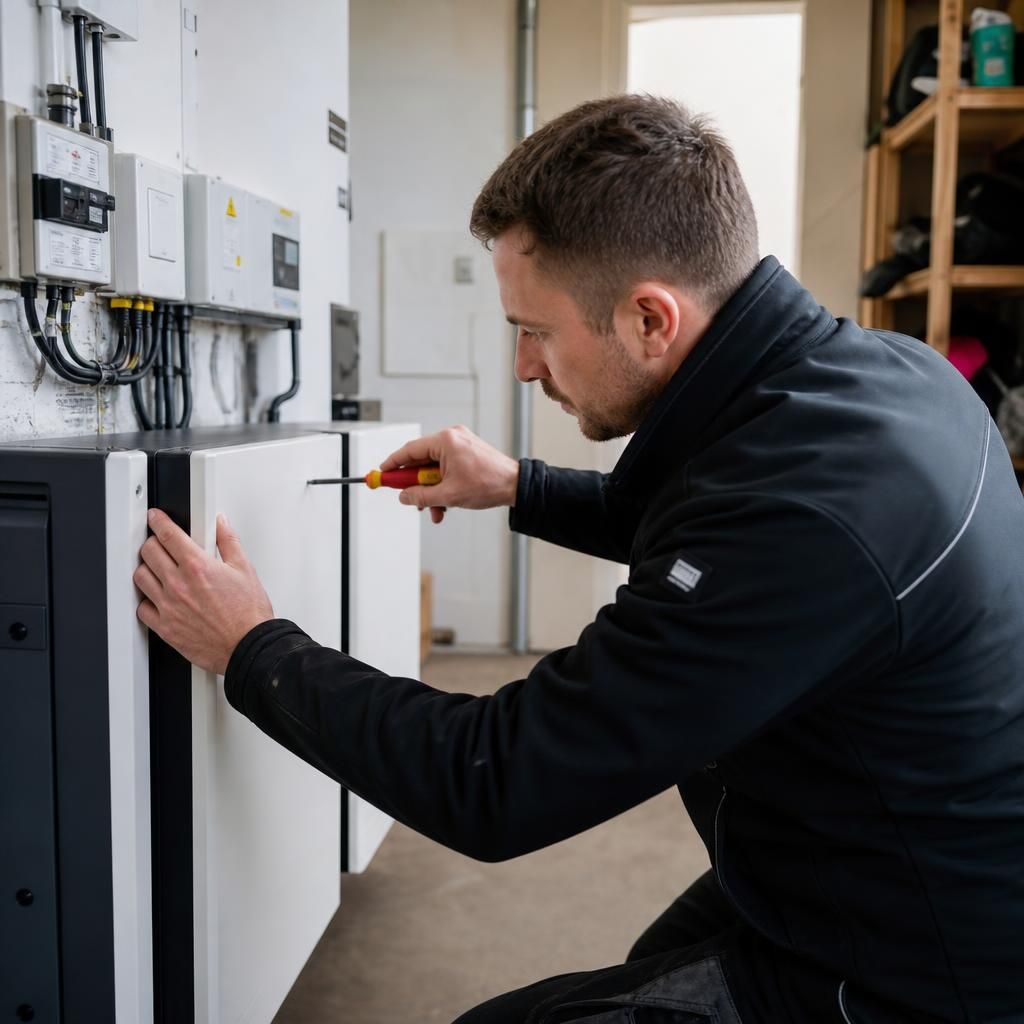
Does a home battery need regular maintenance?
Most home batteries need little routine maintenance, but periodic checks are still sensible for safe, efficient operation. The inspection should follow the manufacturer’s guidance and include the battery unit, connections, ventilation and system monitoring.
There is no universal annual service interval for a home battery. The manufacturer’s instructions, the battery model, its location and how the system operates determine what maintenance it needs. Most owners do not need to service the battery themselves, but a planned inspection can identify faults before they affect charging, exporting or backup power.
Routine checks usually focus on the electrical installation rather than opening the battery. Our engineer reviews the battery’s status, error history and charge and discharge behaviour. We check the isolation points, protective devices, cable connections and enclosure for signs of heat, damage or moisture. We also confirm that the battery communicates correctly with the inverter, solar system and monitoring app.
A firmware update may be needed if the manufacturer has issued one. We only apply updates that are appropriate for the installed equipment and check the system afterwards. The service record can also confirm the settings for export, charging periods and backup operation remain suitable for the way the household uses energy.
Some simple observations can be made between professional checks. Keep the area around the battery clear, dry and free from stored items. Do not cover the unit or use it as a shelf. Check the app for repeated warnings, unusual charging behaviour or a sudden loss of communication. A single temporary notification may not indicate a serious fault, but repeated alerts deserve investigation.
Do not remove the battery cover, alter wiring or attempt to reset an electrical fault internally. A home battery can retain dangerous electrical energy even when the solar panels are not producing power. If you notice a burning smell, scorching, swelling, leaking, unusual noise or excessive heat, keep away from the equipment and arrange an urgent assessment by a suitably qualified engineer.
Maintenance is particularly useful where the battery sits in a garage, plant room, loft or outbuilding. Dust, damp, restricted airflow and large temperature changes can affect the surrounding installation. The battery itself may be designed for that location, but the cables, isolators and ventilation still need to remain accessible and in good condition.
The manufacturer’s service requirements also matter for warranty support. We record the checks carried out, any readings or fault codes found, and recommendations for follow-up work. Keeping installation documents and service records together helps if the battery needs a warranty assessment later.
If the system is performing normally, maintenance may simply confirm that no remedial work is needed. If we find a loose connection, damaged cable, failed protection device or communication fault, we explain the problem before carrying out further work. Any replacement part or additional repair should be agreed in advance, rather than appearing as an unexpected charge.
For a battery installed with solar panels, we can assess the battery and the connected electrical system together. That is useful when an older installation has been extended, when the household’s energy use has changed, or when the battery no longer charges and discharges as expected. The inspection then looks at the complete system rather than treating the battery fault in isolation.
The right time to arrange a check is when the manufacturer recommends one, when the app shows a persistent fault, or when the system’s behaviour changes. If there is no stated schedule, we can review the installation and explain what should be monitored and how often a professional inspection is sensible for that particular battery.
Maintenance cannot restore capacity that battery cells have lost through age. If the battery now runs for less time, we compare its charge level, household demand and system records to identify the cause.
That assessment helps separate a settings issue from normal battery degradation or a fault in the inverter or controls. We explain what the evidence shows before recommending further work, so a replacement is not assumed when a smaller correction may resolve the problem.