
Can solar thermal panels work with my existing hot-water cylinder?
Often, but not always. We check whether your cylinder has a solar coil, suitable connections and enough capacity; a standard single-coil cylinder may need replacing or upgrading.
The key issue is not simply the cylinder’s age. Solar thermal needs a dedicated heat exchanger, suitable controls and enough stored hot water to use the heat collected during the day.
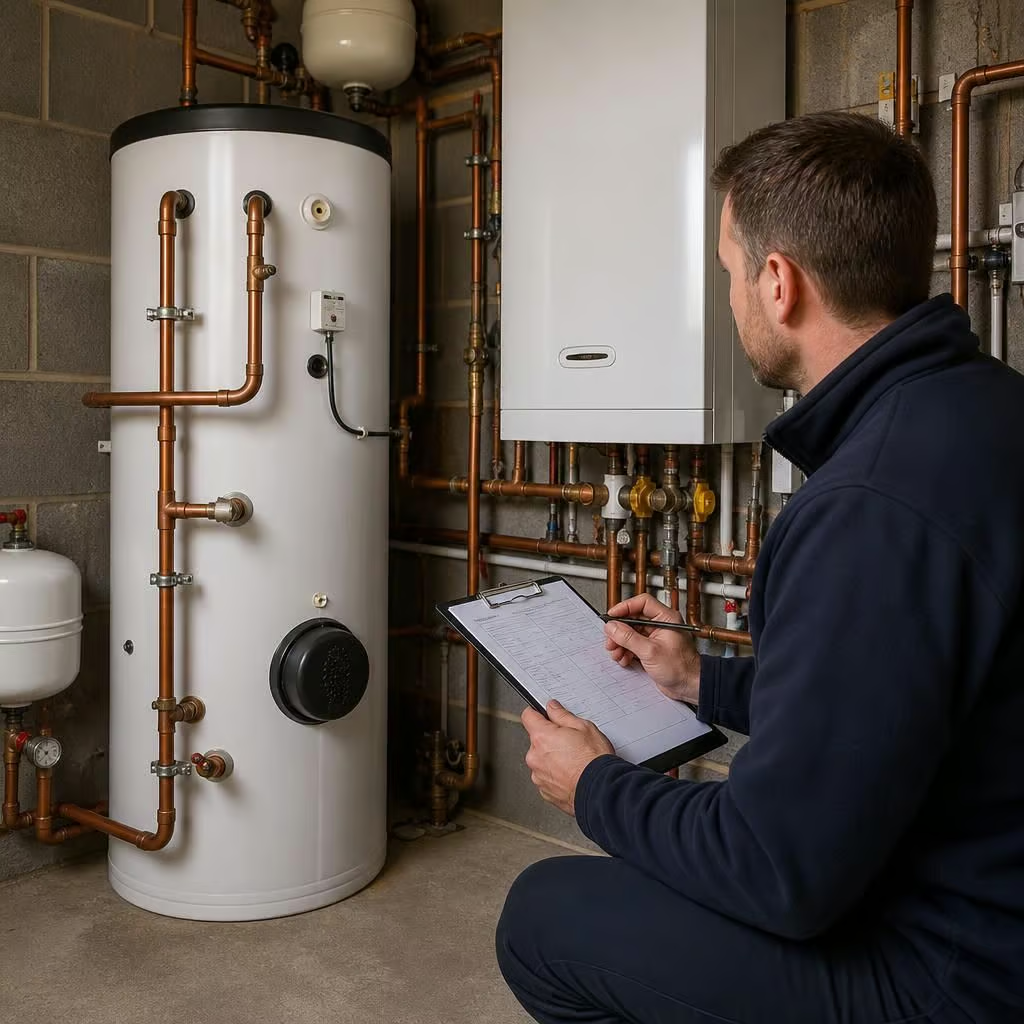
We check the cylinder’s specification rather than judging it by appearance. The inspection covers:
- the number and position of its internal coils;
- the cylinder’s capacity and condition;
- the insulation around the cylinder and connected pipework;
- the available sensor pockets and control connections;
- the route from the roof to the cylinder; and
- how the boiler or immersion heater currently provides backup heat.
A cylinder with two suitable coils may already be arranged for solar thermal. The solar circuit normally connects to the lower coil, while the boiler uses the upper coil to bring the water up to temperature when sunlight has not provided enough heat. We still check the cylinder’s data plate and installation details, because two coils alone do not prove that it is suitable for a solar system.
A standard single-coil cylinder cannot usually accept solar heat safely. Its existing coil is already used by the boiler, so it has no separate heat exchanger for the solar circuit. In that situation, we specify a twin-coil solar cylinder and connect the boiler, solar circuit, temperature sensors and backup controls correctly.
That replacement is also an opportunity to deal with a cylinder that is poorly insulated, corroded or too small for the household. A larger cylinder can make better use of heat collected earlier in the day, but we size it around hot-water use, available space and the rest of the heating system. Installing a larger cylinder without checking those points can create unnecessary cost and disruption.
Properties with an older vented system need a different assessment from homes with an unvented cylinder. We check the cold-water storage arrangement, expansion provision, safety controls and available pressure before recommending changes. An unvented cylinder also needs the correct temperature and pressure protection when solar heat is added.
If the home has a combi boiler and no separate hot-water cylinder, solar thermal cannot normally connect directly to the boiler as a simple add-on. We would first assess whether there is suitable space for a cylinder, along with the pipework and controls needed to store solar-heated water. If there is no practical location, the installation may not suit the property.
The cylinder is only one part of the assessment. We also consider roof orientation and shading, the distance between the roof and cylinder, pipework routes, insulation, hot-water demand and the position of the collector controls. Older homes, barn conversions and properties with awkward roof spaces often need more careful routing, but the survey shows what can be done before any work starts.
Replacing the cylinder usually means draining the existing hot-water system, disconnecting the old connections and making good the new pipework. We plan the location and route in advance so the work does not involve avoidable alterations. The final quotation sets out the cylinder, controls, pipework changes and any associated electrical work before installation begins.
After commissioning, we set the solar controller to work with the cylinder and the existing backup heating. You can then see when the solar circuit is collecting heat and when the boiler or immersion heater is providing additional heat. The system still supplies hot water when solar input is low; the boiler or immersion heater remains the backup rather than leaving the cylinder dependent on sunshine.
For a firm answer, we need the cylinder details and a view of the existing system. A photograph of the cylinder label, its surrounding pipework and the boiler can help, but we confirm compatibility during the site survey. We will tell you if the existing cylinder can be retained, needs a minor control change or should be replaced before solar thermal is installed.
Solar thermal fluid never mixes with the water you use at the taps. It circulates through a separate, sealed roof circuit and transfers heat through a coil inside the cylinder. That separation protects the household water supply and lets the boiler or immersion heater remain independent.
This is why a cylinder can look suitable but still be incompatible. The internal coil must be designed for the solar circuit, with the correct connections and controls for safe heat transfer.