
Can solar water heating work in an older home?
Yes—solar water heating can work in an older home, provided the roof, cylinder and pipe routes are suitable for the system. We assess the property first, including roof condition, available sunlight and any practical constraints caused by solid walls, listed features or an off-gas-grid heating system.
Older construction does not rule out solar water heating. The main question is whether the system can be fitted without creating problems with the roof, hot-water arrangements, planning requirements or internal pipework.
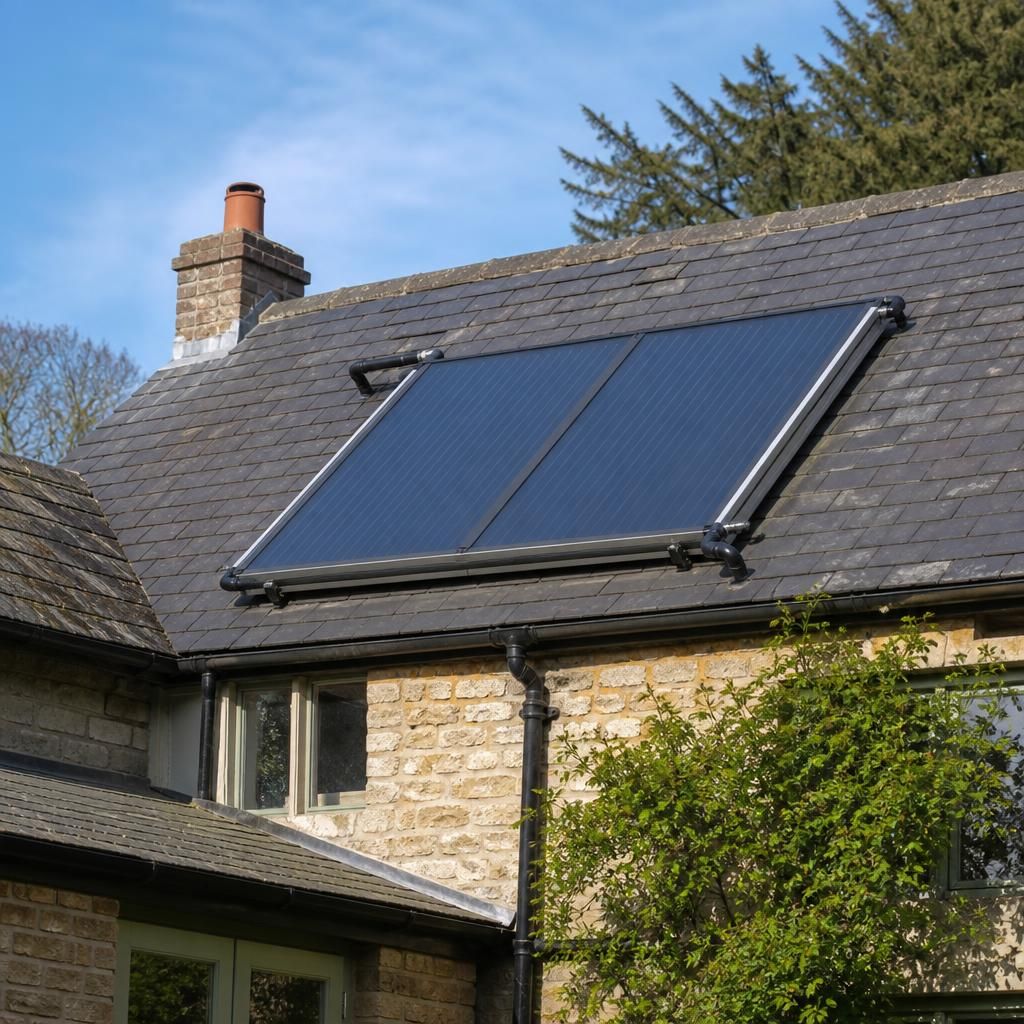
The roof needs more than enough sunlight. A traditional roof may have several sections, dormers, chimneys or nearby trees that affect the collector position. We look at the usable roof area and the sun’s path rather than assuming the largest roof slope is the right one. A less obvious roof face may produce a better result if it avoids chimney shadow or surrounding buildings.
Older roofs also need careful handling. Slate, handmade tiles and irregular roof structures may not accept standard fixing methods without adjustment. We check the roof covering and supporting structure before recommending a collector position. If the property is listed or lies in a conservation area, planning restrictions may affect the appearance and position of the collectors. We explain that risk before any work is agreed.
The hot-water system is often the deciding factor. Solar thermal usually works with a hot-water cylinder that has a dedicated coil for heat from the roof. Many older homes already have a cylinder, but it may not have the connections or controls that a solar system needs. In that case, we may recommend replacing the cylinder or altering the associated pipework.
A property with a modern system boiler and cylinder may need only targeted changes. An older vented system can also be suitable, provided the cylinder, expansion arrangements and controls are checked. A home with a combi boiler and no cylinder needs a different approach because solar heat has nowhere to be stored. Adding a suitable cylinder takes space and changes the way hot water is controlled, so we include that practical issue in the assessment.
Limited cupboard space does not automatically end the project, but it can affect the design. The cylinder may need to sit in an airing cupboard, utility room or another location with suitable access. We consider the cylinder dimensions, access for future maintenance and the route for the solar pipework before selecting equipment.
Traditional interiors can usually be protected with careful routing. Solar thermal collectors need flow and return pipes between the roof and the cylinder. In an older house, the shortest route may pass through a visible room, thick masonry or a finished ceiling. We look for routes through existing cupboards, roof voids and service spaces first. Where a wall or floor must be opened, the quotation identifies the work involved rather than leaving it as an unknown.
Solid walls, exposed beams and original plaster make disruption more noticeable, so the pipe route matters as much as the collector position. We discuss where the pipes and controls will sit, how the roof entry will be weathered and what will need making good. The installation may be technically possible but unsuitable if the only practical route would damage important internal features.
Solar water heating can help an off-gas-grid home, but it does not replace the main heating system. An oil, LPG, electric or other heat source still provides hot water when the collectors cannot supply enough heat. The solar system works alongside that heat source, with controls directing the boiler or immersion heater to provide the remaining heat.
That arrangement can be useful in a rural property where hot water is currently produced by oil or LPG. The value depends on the household’s hot-water use, roof conditions, cylinder size and the cost of the existing fuel. We work through those factors for the property rather than presenting a general saving that may not apply.
Winter performance also needs realistic expectations. Shorter days, low sun and cloud reduce the available heat, so the backup boiler or immersion heater remains important. The system should be sized and controlled around that seasonal change. Oversizing the collectors will not solve a winter shortfall and may create other design problems during warmer periods.
The survey should identify problems before installation starts. We examine the roof covering, fixing options, shading, cylinder arrangement, available cupboard space, pipe routes and the existing heating controls. We also check how the work fits the character of the property and whether planning or building-control considerations need attention.
After that assessment, we explain which parts can stay, which need changing and where the installation would be visible. The written quotation sets out the equipment and associated work before anything begins, so a cylinder replacement, pipe alteration or access requirement is not introduced as a surprise charge later.
For an older home, the best outcome is not simply a collector on the roof. It is a system that fits the building, stores heat safely, works with the existing backup heating and can be maintained without damaging the property. If those conditions cannot be met sensibly, we will explain why another hot-water or renewable arrangement may be more appropriate.
Solar heat can make the cylinder water hotter than your existing boiler normally does, particularly on bright summer days. That matters in an older home where the taps and shower fittings may already be in place.
We include the necessary temperature controls so hot water reaches the outlets at a safe, usable temperature. The backup boiler or immersion heater then takes over when the stored water needs more heat. This lets the solar system work with the house’s existing hot-water routine without making everyday use unnecessarily complicated.