
How well does solar water heating work in winter?
Solar water heating can still contribute in winter, but shorter days, lower sun and cloud mean less hot water than in summer. Your boiler or immersion heater provides backup when the panels cannot meet demand.
Solar water heating remains useful in winter, but it usually contributes less heat than it does in summer. The system may preheat the cylinder on a bright winter day, while the boiler or immersion heater supplies the remaining heat when solar energy is limited.
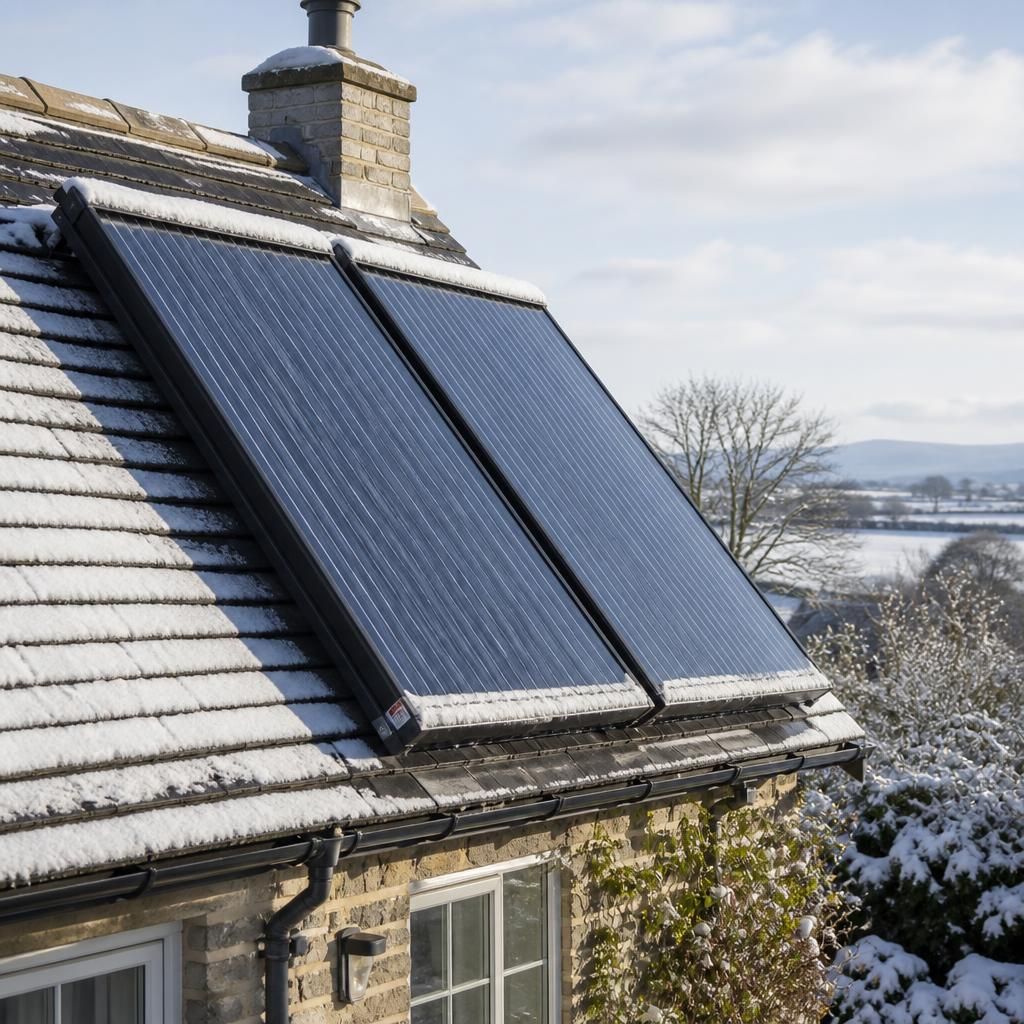
Winter performance depends more on the available daylight than on the air temperature. Solar thermal collectors can absorb heat from sunlight even when the outside air feels cold. They can also gain some heat through thin cloud, although heavy cloud and short daylight hours reduce the contribution.
Your hot-water demand may also be higher in winter, so the solar system has more work to do. A family using more hot water can use the available solar heat quickly. The cylinder controls then call for backup heating rather than leaving the water below its required temperature.
We size the collectors and cylinder together, then set the controls to give solar heat priority. Your boiler or immersion heater only makes up the shortfall. That means winter operation does not depend on solar energy covering every hot-water demand by itself.
What happens on dull winter days?
On a heavily overcast day, the collectors may add little heat. The system still monitors the collector and cylinder temperatures, so the backup heater can take over when necessary. You do not need to change the system manually each time the weather changes.
Snow can temporarily cover the collectors, but it often clears as the roof warms. We consider roof pitch, exposure and access during the survey. Shading from trees, chimneys or nearby buildings can have a greater effect because it may remain throughout the day.
The roof and cylinder affect winter results
A south-facing roof is not the only possible option, but orientation and pitch affect how much winter sun reaches the collectors. We assess the roof rather than assuming that its direction makes the property suitable.
Your cylinder needs the right space for the solar coil and the available hot-water capacity. If the existing cylinder cannot accept solar input, we explain whether replacement or alteration is practical. The cylinder must also work with the existing boiler or immersion heater.
Older houses can use solar water heating, including properties heated by oil or LPG. The building’s age does not decide the outcome on its own. Roof condition, shading, pipe routes, cylinder arrangements and hot-water use matter more. We check those points before recommending equipment.
What winter costs and savings look like
Winter savings cannot be judged from the panel area alone. We work from the household’s hot-water use, the existing fuel, the cylinder arrangement and the roof conditions. A property with modest hot-water demand may use less of the available solar heat, while a larger household may use more of it.
Solar water heating normally works alongside another heat source rather than replacing it. You still need a boiler or immersion heater for periods of low solar input, and that backup should be included when comparing installation costs and expected running costs.
Our winter checks before installation
- We assess roof direction, pitch, shading and the condition of the roof covering.
- We check the cylinder, boiler or immersion heater and the route for solar pipework.
- We discuss hot-water use so the collector and cylinder capacity match the property.
- We explain how the controls switch between solar input and backup heating.
- We identify access, maintenance and any work needed inside the property before we price the installation.
The result is a system designed around the amount of hot water your home uses and the solar resource your roof can provide. If the winter contribution would be too limited to justify the work, we explain that before installation rather than presenting solar water heating as a complete replacement for the existing heating system.
Cold weather can reduce the heat reaching the cylinder if warmth is lost along the pipe run. We plan the route carefully, insulate the pipework and set the circulation controls so collected heat reaches the cylinder efficiently.
Frost protection also matters on winter nights. The system design determines whether the collector circuit uses antifreeze or another method, so we check this before installation and explain the maintenance it needs. That helps protect the equipment without suggesting that solar water heating will replace the boiler or immersion heater in every season.