
Will my solar panels still generate during inverter repairs?
Your panels may still produce DC electricity in daylight, but the system normally cannot use or export it while the inverter is isolated for repair. Until the inverter is working again, your solar generation will therefore be unavailable to the home.
In a standard solar PV system, the household will normally draw from the grid while the inverter is unavailable. The panels do not usually provide usable electricity directly to lights, sockets or appliances.
The result depends on the type of system and the fault. With a string inverter, one failed inverter can stop generation from the whole array. The panels may remain physically intact, but they cannot supply the property until the fault has been repaired or the inverter has been replaced.
A system with panel-level inverters can behave differently. A fault may affect one panel or a section of the array rather than every panel. We identify the equipment layout before deciding how much generation has been lost.
During the repair, these parts of the system may be unavailable:
- Solar generation: the house cannot use the array’s output until the conversion equipment is operating correctly.
- Export: electricity cannot normally be sent to the grid while the system is offline.
- Battery charging: a battery connected through the affected inverter may not charge from the panels.
- Battery backup: any backup supply may also be unavailable, depending on how the battery and inverter are connected.
Your home will still receive electricity from the grid unless the fault has affected another part of the property’s electrical installation. A solar inverter fault does not usually mean that the rest of the home’s power must be switched off, but the equipment must be treated as live until we have isolated and tested it.
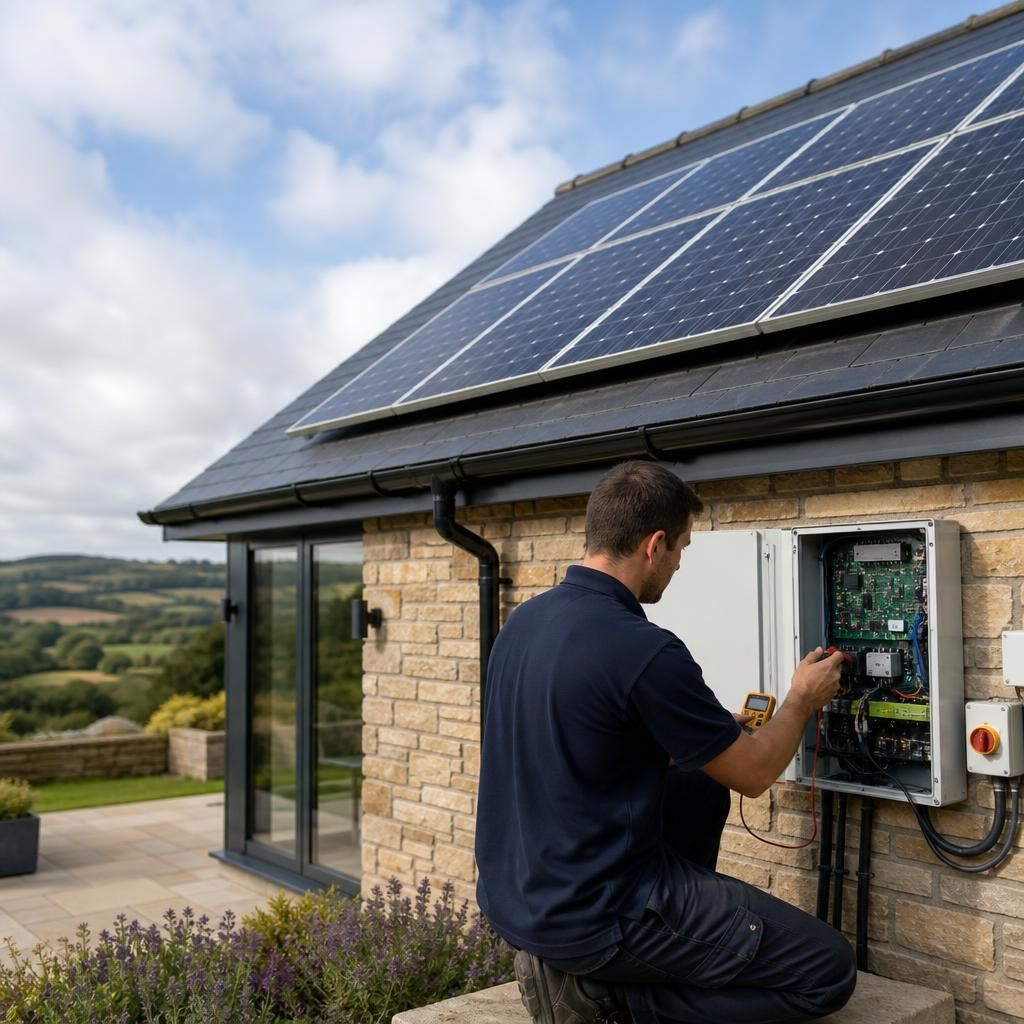
We check the inverter display, fault history, isolation points, cabling and protection devices. We also check whether the problem sits with the inverter itself or with the array, battery, meter or wider electrical installation. A blank display does not by itself prove that the inverter has failed.
If the repair involves removing covers, replacing components or changing the inverter, we isolate the relevant circuits first. We do not ask you to open the inverter or reset equipment repeatedly. Solar panels can continue producing electrical energy in daylight, even when the system appears switched off.
Once the work is complete, we test the DC and AC sides, confirm the inverter settings and check that the system starts correctly. Where the installation includes monitoring or a battery, we check those connections as part of recommissioning. Generation should then appear on the inverter or monitoring system when there is enough daylight.
The length of the interruption depends on the fault, the part required and whether the existing inverter can be repaired. A diagnosis may show that a reset, connection fault or protective device is responsible. Other faults require a replacement component or a new inverter, which can extend the period without generation.
Keep any inverter fault code, warning message or monitoring notification available when you contact us. A photograph of the display and details of any recent electrical work can help us assess the problem before attending. We can then tell you what information is needed for the repair and whether further testing is likely.
While the inverter is unavailable, the home may use more electricity from the grid because the solar array cannot offset normal demand. The effect on your bill depends on how much electricity the property uses and how long generation is interrupted. Once we’ve repaired or replaced the inverter and confirmed safe operation, normal solar generation and export can resume.