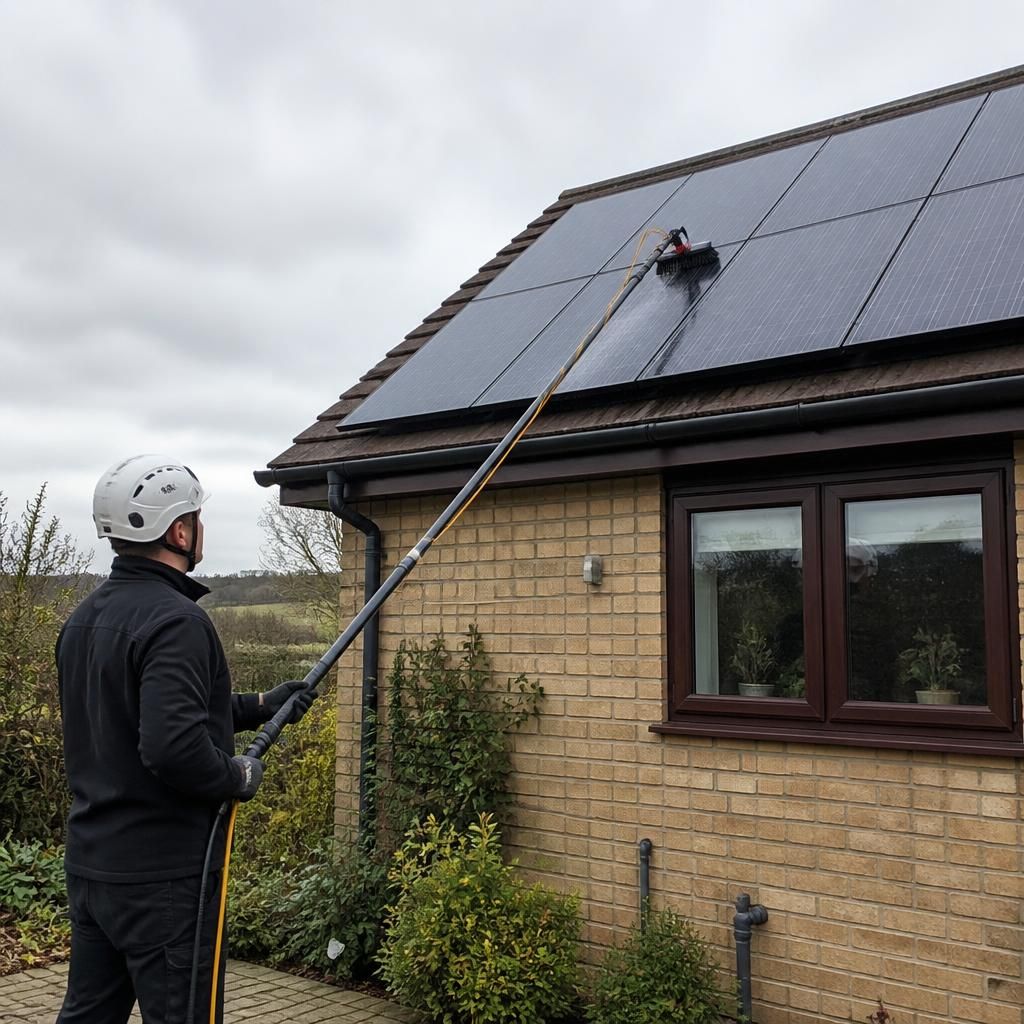
Can solar panels be cleaned without walking on the roof?
Yes. Solar panels can often be cleaned from the ground or from a safe access point using telescopic, water-fed equipment, so nobody needs to walk on the roof; the method depends on the roof height, pitch and panel arrangement.
In many cases, we can clean solar panels without anyone walking on the roof. The method depends on the panel height, roof angle, surrounding buildings and whether a pole can reach every panel safely.
A telescopic water-fed brush is usually the most practical option. The operator stays on the ground or on a suitable safe surface while the brush reaches the panels. Purified water helps lift dust and grime without leaving mineral marks as it dries. The brush should be soft enough for photovoltaic glass and used with controlled pressure.
Some roofs make ground-level cleaning unsuitable. Panels may sit above a conservatory, behind a parapet or on a steep roof that a pole cannot reach evenly. Trees, dormers and narrow access routes can create similar problems. In those cases, we assess whether suitable access equipment can reach the panels without using them as a walkway. If no safe method is available, we will explain that before cleaning starts.
Walking directly on panels is not a safe substitute for proper access. Their glass can crack under a concentrated load, and the frame, wiring or mounting system can suffer damage that is not immediately visible. A wet roof is also slippery, while older tiles and roof coverings may not tolerate foot traffic. Avoiding the panels does not remove every roof risk, so the access route still needs checking.
Cleaning equipment matters as much as the access method. We do not use abrasive pads, harsh chemicals or high-pressure washing on solar panels. These can mark the glass, damage seals or force water into parts of the system that should remain dry. We also avoid working on very hot panels where water could dry too quickly and leave deposits.
Light dust is often dealt with by rainfall, but bird droppings, pollen, tree sap and traffic residue can remain. Bird droppings are particularly worth removing because a small, hard patch can shade part of a panel. We look for heavier deposits rather than assuming that every array needs a full clean.
Before starting, we check the panel layout, roof condition and the safest position for the operator. We also look for cracked glass, loose cables, damaged frames and signs of water ingress. Cleaning will not repair those faults, and disturbing a damaged panel could make the problem worse. If we find an electrical or mounting issue, we report it separately so you can decide what to do next.
A clean should not involve disconnecting the system simply to reach the panels. Solar equipment can remain electrically live in daylight, even when the inverter is switched off. That is why we keep clear of exposed connections and follow a safe method around the array and its cabling.
After cleaning, we check that the panels are free from obvious residue and that no equipment has been disturbed. If the array is difficult to reach, a survey gives you a clearer answer than relying on the roof appearance from the ground. It also shows whether cleaning is worthwhile for the property and whether the work can be completed without putting the roof, panels or people at unnecessary risk.
Keeping feet off the roof does not automatically make a cleaning method safe. The operator must see the brush head across the whole array and control it without stretching or pushing against the panel frames.
A long pole can flex when it reaches the far edge, making precise work difficult. We judge the method by control as well as reach. If any section can only be cleaned while working blind or leaning across the roofline, we stop and explain the safer alternatives.